
Stars Are Not Small
(a novel)
Part 1: Frail and Small
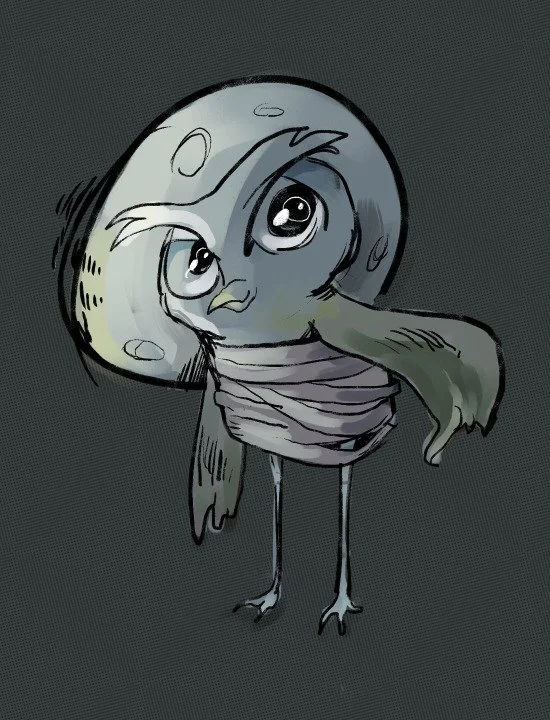
There was once a little owl named Isiah. His egg was the size of a small stone. His mother and father were the size of buildings, and made their nest on the moon.
He was the first to hatch, but the others quickly outstripped him in size. They grew, and he did not.
And they left, to live in the stars. He could not make the journey and plummeted through space.
He awoke in an old woman’s home. The home was littered with knobby wooden furniture that spoke of old fashions.
Wrapped in bandages, the owl hurriedly hopped to his feet. There, he was greeted by an equally little woman in a ladybug dress. Her garb was Peruvian, and she wore a little beige bowl hat tied by a string. Her hair was as silver as the moon.
“Where are the stars? I can’t see them. You’ve covered them up!”
The old woman opened the front door, and showed him the sky.
“Oh, the stars are much smaller here.” Isiah says.
“Stars are not small, my dear. It only appears so, from this distance.” The woman replies. She holds her fingers out, and pretends to pinch one.
“Is that so? Then I only appear small at this distance!” He laughed.
And this thought kept him happy, while he healed.
They found comfort in each other’s frailty, and their smallness. Sometimes the old woman liked to sip tea and spit it down the cliff to see if she could surprise someone.
“Will you make me a moon, which only appears small at a distance? I cannot reach my home, anymore. ” Isiah asks, one day.
And she makes him a little puffy pillow, in the likeness of the moon. Embroidered on the pillow, was the woman’s name, Selene. Whenever she asked him if he wanted to leave, he would point to his bandages, and say he was still hurt. And she accepted the excuse with a cluck of her tongue.
The woman, on her deathbed, asked Isiah for a favor.
” My children have not visited me. Eight of them, and I have not heard a peep. For them, I promised to keep my home lit, so they could always find their way back. I fear they must be lost. Would you please check up on them?” Isiah knew who she spoke of. Above the mantle hung a faded family portrait. Surely, the children in the picture must be adults now. But he knew it to be them.
“Yes, I will go for you. But it is a big world. Tie my favorite pillow on my head, so that I may not lose it. Fasten my bandages, so I do not forget my injuries. I love you.”
And Isiah left. The home burst into flames.
Part 2: Home and Smoke
Isiah says farewell to his home underneath the stars.
The burning home had been wedged into the side of a rugged mountain. The cliffs were a muted and dark grey, dotted with a few scraggly and barren trees. There was no greenery, only sharp and twisted rock.
The little owl struggled to climb down the rickety, wooden steps, until he reached solid ground.
“Oh, how tiring! The old woman was never able to walk well,” Isiah says, “but I have much better feet. Yes, indeed….”
He looks up, to see that the cottage is nothing but a flaming silhouette. Fire licked out the windows, along with plumes of smoke.
The flames reflect in Isiah’s dark eyes, as he watches in the dark. The staircase collapses, crumbling to pieces.
“Oh, her home! The old woman met her end in that home,” Isiah says, “but I must find another. Yes, indeed….”
Isiah looks down the mountain path, full of dangerous twists and turns. Neighboring cliffs can be seen, foggy and transparent in the distance. The way is shrouded in night, and barely visible.
“Oh, what darkness! The old woman was never able to see well,” Isiah says, “but I have much better eyes. Yes, indeed….”
He disappears from sight as he continues onward, eaten up by the darkness.
“Indeed, now I understand why she stayed.”
The home would burn for centuries, as the old woman promised: forever lit.
Part 3: Toil and Danger
Isiah wanders in the darkness. Soon, his face is lit by the glow of dancing fireflies.
“Hello, tiny stars.” Isiah says, wistfully. “Did you fall too?”
One lands on his wing. It appears to be a tiny bulb, the size of a bean, with flimsy wings. It flies off, and Isiah watches it longingly.
From this height, Isiah can see a large light on another canyon. He decides to head there. The path begins to narrow and he is forced to travel on a rail-thin ledge alongside the mountain. Isiah then hears the snorting of a large animal.
Up ahead, he sees a burly kid riding atop a sturdy Himalayan Yak. Over a shoulder he carries a huge sack of sharp glass. The boy’s nearly hit puberty, approaching the age of 12. Something in the bag is glowing dimly. It is heavy, but has room to spare.
“Do you know the little old lady, who lives on the mountain?”
“No. I only know of a little mother, who lives in the mountains. Once I have emptied my bag, I will visit her.”
“Good son, what are you doing here?” Isiah questions.
“I am called Martin. I am here to pick up dangerous things so others cannot hurt themselves on them. I plan to clear the path up and down these mountains, so it can be traveled freely.”
“I do not see anything dangerous.”
“That is because I have picked them all up. But you never know when you’ll come across something new.”
“How do you judge what is dangerous?”
“Oh, I just put it all in the bag. It’s too dark to sort it all out. ” He grins.
“That seems a burden to bear, brother.”
“I will carry the burden. You see, there is no one else here to pick up things. And there are many harmful things to put in my bag.”
“There is light coming from that bag. Did you not put it in there on purpose? Surely it is helpful to you.”
“A coincidence! If it is in the bag, it is for one reason.”
The kid leans over. He grabs the owl by his puffy hat, lifting him with one hand.
“Now, do not be offended, but your beak is very sharp. It could snip someone’s fingers off. I will have to put you in my bag, as well.”
“I suppose so,” Isiah says, “but I have never done such a thing.”
Isiah is put in the bag. When the man is sleeping, Isiah pokes a hole in the material with his beak, and slips out. The Yak eyes him, beneath its mop of hair.
“I am sorry to have ruined his bag, but I cannot stay with the rest of his things,” Isiah says, unhappily, “True, my beak is sharp, but it has brought me much use! I am many more things than dangerous.”
Isiah peeks back into the bag, lifting the corner up with his wing. Several fireflies dance out of the bag, whizzing by him. The owl pulls out a broken teapot, made of glass.
“Indeed, this teapot could harm me with its broken lip…. but I am sure it, as well, must be more than that.”
Isiah tucks it under his hat, and wanders back into the dark.
Part 4: Apathy and Sleep
Again, Isiah wanders in the darkness, carrying his teapot on top of his hat. He sees a herd of eyes, gleaming in the dark.
Surrounded by sleeping alpaca is a young teenager. He has a needle and thread in his hands, and he is sitting on a tiny stool. The sky is as dark as ever. He is pale, with dark bags under his eyes.
“Do you know of a little old woman, who lives in the mountains?”
“Only as a boy. You may call me Hermes.”
“What are you doing here, shepherd? She has been waiting for you.” Asks Isiah.
“I do not care. I am busy weaving blankets from my alpaca’s wool. I will see her soon.” The shepherd answers, lowering his head in guilt. There are brightly striped Peruvian blankets underneath his feet.
“Who are they for? This many blankets could warm a village.”
“Once, making these blankets brought me joy. It was my greatest happiness, ” The man leans forward even further, his hands slowing, “my mother said I was very talented, so I sought to bring home an even greater talent. But my talent stagnated. So too, did my joy.”
“Then why have you not stopped?” Isiah replies, taking a seat at the edge of the blanket.
“I have spent my whole life on this pursuit. I know nothing else. It is my only lover. No…. I will continue, with the hope that joy is waiting around the corner.”
“And if that joy is a noose?” Isiah says.
“Then I shall fasten it around my neck. If my joy returns to me, it will be in no other form but weaving. I will make sure of it. Joy from weaving, that is the only kind I will take.”
Isiah is tired. His eyes droop. He watches the alpaca, instead of the man on the stool.
“You are strong.”
The shepherd sighs, “And very weak. Sleep, owl. And when you are rested, take a ball of my yarn with you, so that you may carry my joy and noose.”
The shepherd sits upright again. He weaves into the night.
Isiah sleeps among the alpaca, gazing up at the towers of blankets. A freshly sheared alpaca finds a blanket to sleep under.
Part 5: Guilt and Health
Isiah comes across a temple, with gently sloping hills. He carries the teapot on his head, and the yarn under his wing. There, he meets a shaman. The shaman’s face is covered in paints, and he has a sickly hue to his skin.
The medicine man is wrapped in many scarves, and Isiah sees him grinding medicine in a clay bowl. There are multiple bowls surrounding him. He has an Andian satchel across his hip.
He sneezes, sitting cross legged. A variety of guinea pigs scamper around his feet.
“Do you know of a little old lady, in the mountains?”
“Yes. She is my mother, who has shown me nothing but wisdom and kindness. I send her my prayers, so that she may live a long life. My name is Jove.”
“Shaman, why are you here by yourself? Is it not time to return home?”
“I enjoy it. Has she sent you?” He says, unconvincingly. Isiah nods.
“I find tranquility in this isolation. My mother will understand.”
“Even if she understood, would that change that she misses you?” Isiah asks.
“No, not at all. And for that, I feel guilt. Is my own personal happiness more worthy than her own?”
“I do not think you can measure emotions with rulers and sticks, shaman. All I know, with my own two eyes, is that you look very sick.”
“Ah, is that so? I am very healthy, compared to my neighbors, in the lands nearby. Poverty and plague has struck them.”
“Does their health matter so greatly?”
“Everything must be seen in perspective. In perspective, I am doing perfectly fine.” He smiles.
“And in perspective, I am only small at a distance! Your mother taught me this. But perhaps, there are times where you must see what is in front of you. ”
Isiah looks to the medicine, meaningfully.
“There is plenty of medicine here for you to take, is there not? It is right there, in front of you.” Questions the owl.
The brother dismisses this. “That is for the sick. I have already been selfish enough. I am whole, and want for naught.”
“You are very humble.” Isiah says.
“From your perspective, not mine.” The shamans says, jokingly. “Drink from this cup. If you continue this way, the plague will reach you. This will keep it from entering your temple.”
And so, Isiah drinks some of his offered a herbal medicine, although he is not sick at all. He asks to take some with him, and the medicine man ties a sack to his bandages.
Part 6: Denial and Weeds
Isiah comes down the hills, reaching terraced farmland. They spread out before him in rolling platforms. The owl is dirty, but his eyes are still wide and curious. There is a farmer clearing weeds. She is malnourished, with sunken cheeks and mud-stained hems.
All of the plants in the upper rows are dead, or partially eaten by insects.
“What are you doing here, with this barren dirt?” Isiah asks.
She turns to him. “Tending to the vegetables. I am pulling the weeds.”
She grunts, and pulls a face to express her annoyance.
“What have the weeds done? Don’t they deserve an equal chance to grow?” Isiah says.
“Little owl, these potatoes are important to me and weeds are not. It’s an easy choice. Do you not see how empty my fields are? If you are only here to gawk, leave!”
The woman is brusque and rude, but she is not upset by the questions. Isiah helps to pull the weeds, and she corrects him on how to do it.
“There are not many vegetables left.” Isiah states, “It looks like they could not co-exist.”
“The weeds, they return the night after I pluck them. Their roots still live in the soil.”
“Must you not remove the roots, then?”
“I cannot remove the roots without removing my plants as well. If I do that, then I must start over. These vegetables will not survive a transplant.”
“Are they not as good as dead, then?”
“Are you saying that I am wasting my time?!” She breathes fire.
“No, farmer…. but would you still remove the weeds, if they were?” Isiah asks, plainly.
“As long as I choose to see life, they are not dead to me.” She says, with determination and a grim look, “I will dig the roots up when it is time to.”
They work until all the weeds are removed.
The gardener gives him a basket for his work. She tells him that once upon a time, it would have been full of fruit. It has a small, ugly, and lumpy beet. “I suppose you want my name? It’s Veneris, you know.”
The owl promises to eat what’s in the basket. Isiah now has his hands full.
As Isiah leaves, he can see the weeds begin to grow again, pointing their tendrils upward. He is saddened by the sight.
Part 7: Secrets and Locks
Isiah approaches the first house he’s seen so far. It’s covered with a huge sheet, with squares cut out for the door and windows. The owl has to set down his belongings so he can tap on the doorknocker.
The person who answers is a grey-ish looking woman. She’s in a potato sack and wearing an ugly mask.
“My name is Mud. I’m very homely looking, aren’t I?” she says.
“Why not take a look in the mirror for yourself.”
“Oh, don’t be silly.” She replies. The owl looks to the mirror, which is draped in a sheet. Her home is littered with spiders and webs. The decor is covered up.
“It is very ugly here, isn’t it?”
“It’s hard for me to tell.” The owl replies, confused. Isiah tries to lift the curtain. The woman frets.
“Oh, no need, no need for you to do that.” She titters.
She continues, “Horrible view from the window, don’t you think?”
The curtains are drawn, so Isiah replies, “I cannot tell, my lady. Why ask? Only you know the answer.”
“Oh dear. But if you see for yourself, you’ll have all sorts of opinions. You might even think worse of it. It is better if I’m the only one who knows truly how ugly this place is.”
She gives Isiah a box, with a lock on it. He asks her to tie it to his back, and she does so. “Do not try to open it. It will ruin what you hope is inside.”
“I would not try.” Isiah says, nobly.
She asks him to turn off the lights so she can pretend her home is more beautiful.
Isiah leaves the home and continues in the dark.
Part 8: Futility and Limits
Isiah comes upon a scribe, tucked away in a cave. He spots the light, and enters. Inside she is surrounded by shelves upon shelves, with knotted strings. The completed quipus are tucked away. Candles flicker. The woman sits and knots.
“What are you doing here, scribe?”
“Excuse me? I am knotting, to fill this library. What are you doing here, hm?”
“A favor for a little old lady.” Isiah says. He is unruffled, but his journeying has aged him. You can see it in his eyes, and hear it in his voice. “What do you write of?”
“It is for the bats. It is their long history, in these knots. Their families and ancestry. They will appreciate these tombs in years to come.”
The bats flap in their cages.
“They don’t seem to care. Why have you kept them here?”
“Do you disapprove?” She says, thinly. Her fingers are thin and long, and she moves them precisely.
“It is not right to keep others in cages.” Isiah says, looking upon them.
“These bats are like unruly children. This is the only way to hold their attention. Otherwise they will run off to play.” She says, “I know it is hard for them, but I must develop their minds. They will read and write, with time. “
“That is too much expectation to put on simple bats.” Isiah says.
“A teacher places expectations on their class. A mother places expectation on her child. A farmer places expectations on their crop.”
She asks Isiah to light another candle. Isiah offers to record in her place, reasoning that her fingers must be very tired. She instructs him carefully.
“If only one bat were so diligent as you.” She says.
Isiah pauses, in thought. He rubs his chin with a feathered wing. “I have only one question, scribe. The bats are blind, are they not? They have no hands either. How will they write and read for you?”
“Their potential is limitless. They can do anything they set their minds to. That I believe. They will open their minds, and open their eyes. They will grow fingers if they will it.”
Isiah says that his eyes have grown tired of the candle’s light. The scribe asks him to recite his history. He does so. As he speaks, she makes a knot for him.
“You carry your history in your heart. But here is your history in knots. Remember my name as Azul.”
Isiah takes a few of the knots, but he doesn’t know what it means. He thanks her. He can’t make heads or tails of the record. He holds it up, and lets it dangle to the floor.
“Perhaps one day I’ll be able to appreciate this…. But for now, I will forget it. I can only manage with what I know, in this moment. ” He says, leaving the cave.
His shadow is cast against the ground, long and wavering. It disappears to nothing as he continues in the dark.
Part 9: Fear and Wolves
Isiah meets the next brother, who resides in a mud hut, with sticks layered on top. The entrance is a metal sheet, with a portion cut out at eye-level. Outsides, the wolves howl.
“What are you doing here, brother?”
The brother peers through the small gap in his wall.
“Shhh, quiet!” The brother’s eyes shift to the left, and then the right. They center again.
“I am no brother of yours, I am Thorndon. I am here for safety. You see, there are wolves outside. You are not a wolf, are you?” He says, nervously.
“No. But I may need shelter from these wolves.”
The brother ushers him in. The hut is covered in rusty weapons.
The brother seems too frightened to speak loudly, and cowers. “They have taken my arm. See how they have bitten me?”
The brother displays his arm stump.
“That is a good reason to hide,” Isiah concedes, “But you must face the wolves eventually. I am here because your mother has died. She awaits your return.”
“Not today. Maybe tomorrow.” Says the wounded brother. He gives the owl a broken letter opener for safety. Its hilt is rusted with blood.
“Can I not have another weapon, one that is more useful to me?”
“That is all I can spare to you, owl. My knives are for the wolves.”
They wait many nights. But the brother continues to give excuses. One after another, the excuses pour like water. Isiah decides to leave without him.
The wolves bite Isiah, and he loses many feathers. But the owl continues onward.
Part 10: Regret and Blood
In a stone church tower, Isiah finds the eldest sister. Everything on the interior is covered in dried blood. It cakes the walls. There was a slaughter here. High, blocky pillars decorate the doorways.
“Who goes there?” The sister declares.
“It is I, Isiah of the Owls. I have come to deliver a message. Your mother calls for you.” Isiah is at the end of his rope. His feathers are beaten, he is covered in wounds on his arms. His items are all tied to his back.
“I have done unspeakable things here. You can never understand. If I leave, I will forget the sight of it. So I must stay here, until my heart ceases to beat.”
“There is someone waiting for you. Surely you will answer their call?”
“Who are they? I have forgotten. I have forgotten so many things.”
“And have you forgotten to clean this place?”
“I cannot wash it away. It is my reminder. ” She nods.
“Then you choose to ignore everything outside these walls? When will you have fully atoned?”
The sister grows violent. “Do you not see me? Do you not see me as I am? There is none.”
“I see Uriah, the daughter of a little old lady in the mountains.” Isiah says, swiftly. “Surely this sight in burned into your mind. If you have done something so terrible, cleaning this away will change nothing. Provide me a bucket, a cloth, soap and water.”
Isiah washes the floors. He washes her blood stained clothes. Uriah sits naked on the stone flooring.
“I can still see the blood.” She gasps and grieves. “Thank goodness….”
Isiah turns to her. “I will take your dress, so that you are not burdened by its stains.”
“Go.” She says, quietly. Isiah smiles kindly and sits with her instead.
He wiggles his small feet. “Let me give you something to replace it. Do you know what has happened to your brothers and sisters?”
“No, Isiah.”
“Then let me tell you. But first, I must ask you something selfish. Your mother and I spent many nights watching the stars together. Will you come outside, and take her place for me?”
“Only for tonight. And you will take place of my 9th brother, the one I never had. His name would have been Pluto.”
Uriah wraps a clean sheet around her waist. They exit the church together, Isiah guiding her with a wing.
Part 11: Gifts and Love
The two watch the stars. Isiah dismantles the worn bandages that hold all of his things together. He spreads them across the ground.
“As I promised, I will replace your dress.” Isiah announces.
He places a teapot in the woman’s hands. “Here is the teapot that belongs to your lost brother, Martes. He protects you from which he deems dangerous. ”
“And what of the pot?”
“It is dangerous!” Isiah exclaims. “This is a wicked pot, which brings death. It has killed hundreds on its sharp lip. Now you must protect others from it.”
Isiah presents the dingy yarn ball to her.
“Here is the most beautiful blanket that your brother Hermes has made. It is his greatest joy. Look how luxurious and soft it is.”
“Is it?” The woman smiles, catching on.
“This is medicine from your brother, the medicine man. It rids a man of all flaws. That is why he is so endlessly kind. There is no greed in his body, thanks to this remedy.”
“How wonderous.” She says, handling it gingerly.
“That is not all. This is a gift from Veneris. This is her plentiful basket of fruit that she has grown to feed you.”
“Plentiful?” She asks, taking the basket. It is almost empty, and the vegetables roll slightly at the movement.
“Is it not plentiful? Are these not fruit to you?” Uriah takes a pathetic beet, and bites into it. “They are better than any fruit.”
Isiah gives her the letter opener, the treasure box, and the knotted record.
“Your brother, Thorndon, is a great warrior. He fights imaginary wolves each day. This is his sword,” Isiah continues, “And this is from Mud, who lives in a gilded mansion. This box holds her great beauty. A man would go blind from the sight, so it is kept locked away, never to be beheld.”
Isiah finally passes her the knotted string.
“In these knots…. The future and past is written. Your wise sister, the scribe, has made it for me. I cannot read it myself, but perhaps you can.”
Uriah pretends to examine it. “I see my past in it. With this, my stains will be seen long after they have faded.”
Isiah nods, “And lastly, here is the moon. Your mother lent it to me. It has been my favorite pillow. But I am in need of a new pillow, and she will surely make me one when I return home…”
“Safe travel, little brother.”
They part. Isiah makes his way back home. Isiah carries the bloody dress away.
Part 12: Ash and Sun
Isiah returns to the charred house. It is still burning, as if no time had passed.
The staircase is gone. Isiah hops a few times, and then bridges the gap by flying over it. As he approaches, he sees a stranger dressed in golden robes. The old man has a walking stick and a sun-beaten, weathered face. Age makes him look fragile.
Isiah passes him a glance. The sun drenched man, with his long white beard, watches Isiah with no word.
“You were the only one that believed in how big I was, Selene. I am sorry I had nothing to bring back but myself and this dress. But you would be proud of your children.” Isiah says, as if speaking to the old woman’s ghost. He folds his stained dress and leaves it on the ground.
“They are well-rested. Strong of mind. Healthy and happy.” Isiah lies.
The night sky begins to rain, dousing the fire. It hisses and fades away.
“Good.” Says the man, with finality, when the fire ebbs. He hobbles towards the house’s doorway.
“They were horrible, self-absorbed adults, were they not?” The old man croaks, “None of them took after her.”
“You did not visit either.” Isiah points out.
“We were not meant to live together. Come, I will make you a new pillow, littlest owl. She would have wanted me to.” The old man beckons with a crooked finger.
They both disappear into the crooked and black house. Years down the road, a massive owl could be seen flying the skies with a sun-shaped pillow tied to his head.